Thursday, October 14, 2010

Socratic Seminar Reflection

During our class's Socratic Seminar, I had question 2, which reflected upon the conversation between John the savage, and Mr. Mond, and question 7 which reflected on the reality of Huxley's Brave New World, based on how society is now.

One of the things that interested me is that I learned a lot from listening to others Socratic Seminar, as well as my own. The group from question 3, brought in to account how Huxley felt about Henry Ford, and questioned whether he looked up to Ford, or blamed Ford for many of societies problems. This was something I had never thought about, before listening to this groups conversation. By talking with others about the book, and the ideas behind it, I was able to better understand the human element behind the book, and how Aldous Huxley presented his ideas through it.

I thoroughly enjoyed question 7, because I could relate Brave New World to present day circumstances, and was able to bring in a lot of outside sources, such as a communique from BRIC, and an article on stem-cell research. I felt I did considerably well. Question 2 I felt was slightly more difficult, because I was forced to step into two different characters shoes, in attempt to understand their brain and subconscious. If I could do the Socratic seminar differently, I would have studied the passage for question 2 more, and would've brought in more examples from the text for question 7. I discovered that I enjoy talking, and can communicate ideas with relative ease, and use my hands a lot during conversation. I really enjoyed how the Socratic Seminar was set up, but I think that have a conversation consisting of me and just someone else, would make it much easier to communicate, and wouldn't leave anyone without anything to say.


Sunday, October 10, 2010

Annotated Reading List for Independent Reading


Collins, Suzanne.
The Hunger Games. New York: Scholastic, 2008. Print. (374 pgs)

In The Hunger Games, Suzanne Collins portrays and teenage girl named Katniss Everdeen, who is sent into a corrupt government's way of controlling the nation's districts. She is meant to fend for herself against Mother Nature's wilderness, engineered and twisted by gamemakers to be twice as deadly, and, to top it off, protect herself from other teenagers, who were forced to represent the other eleven districts. Not only does Katniss face death, but also emotional upheaval, caused by the male participant from her district: Peeta. Peeta is what all girls dread: That guy who claims to love you, who you can't help liking yourself. Although the plot was good, and fairly original, the mushy side of the story made the actions sequences seem sadly watered-down. Peeta is an extremely simple character, who, while adding to the plot, added little to the imagination.

Collins, Suzanne. Catching Fire. New York: Scholastic, 2009. Print. (391pgs)

Katniss is back, and after having won the hunger games, and saving her co-winner Peeta. Unknowingly, Katniss has stirred up some pretty rebellious feelings around the districts. Now she must prove her non-existent love for Peeta, in order to survive. To top it all off, she is forced to return to the arena. Again her wits and will to survive are tested. And so are her emotions.This time, the arena she's thrown into is completely unlike her home. She is forced to survive in a beech like environment, with tropical woods, booby-trapped with all forms of deadly snares. Collin does a relatively good job of explaining Katniss's surrounding, although she does not paint them as well as many authors are able to.

Collins, Suzanne. Mockingjay. New York: Scholastic, 2010. Print. (288pgs)

Katniss is FINALLY out of the arena for good... But life is still extremely difficult. Especially when she finds out that her home, District 12, has been almost completely destroyed. She is rescued, and then recruited to be the face of a rebellion she barely knew existed. Everything she stands for is tested, and she finds herself questioning the values that have held her together. She faces enemies who, can not only kill her with violence, but also with politics and words. For the first half of Mockingjay, the Collins' style is energetic, and pumped, rebellious, and encouraging. Toward the end of the novel, the town shifts into a much more serene quality. Everything has changed, and life itself seems to have fallen apart. There is a quietness, almost a fragile silence. The town becomes almost depressing, despite the changes that should seem positive. The book ends with a solemn view on life.

Mitchell, Margaret. Gone with the Wind. [New York]: Avon, 1973. Print. (1037 pgs.)

Scarlett O'Hara is a sly, and foxy young lady who reaches adulthood just as the civil war begins. Foolish and lovestruck, she chases after Ashely Wilkes, who is betrothed to Melany Hamilton, and makes many idiotic choices concerning the two. The Civil War takes hold of Scarlett's home, stealing places, people, and things she loves. In an effort to survive Scarlett becomes a strong, determined woman who handles the world in a unique, and sometimes immoral way. She continues to battle for what she finds important, while running from fears, until forced to confront what has been eating away at her subconscious for years.

In her novel, Gone with the Wind, Margaret Mitchell expresses ideas in a way that captures the reader, and holds there attention. Her style is unbiased, yet sarcastic to the foolishness of society in general. Mitchell had an extraordinary way of understanding what truly makes people tick, and how the differences in people can cause truly interesting reactions to the situations life gives us. Enforced by tons of research and facts of the civil war, Mitchell reminds us of basic human nature, in a touching, and intriguing story of a girl changing into a woman. Gone with the Wind expresses determination and victory despite all odds.

Saturday, September 11, 2010

A Whole New Mind: Abundance

Dan Pink's sarcastic reply to the wastefulness of Americans in the passage "Abundance" from his book, A Whole New Mind, thoroughly explains how the abundance created by our great-grandparents has caused Americans to search for purpose and meaning through aesthetic and spiritual means. Pink reveals a new light to this country's wastefulness by using captivating statistics that shame stuff-loving teenagers, like myself. To top it off, Pink uses diction that truthfully describes the surprising size of aesthetic industry.

Pink reveals the extent of greed in America by explaining how "Self-storage - a business devoted to providing people a place to house their extra stuff - has become a $17 billion annual industry," a larger industry then the movie business. Now think about how many times you head out to the movie theater a month, how many movies are stacked next to your TV, how much you spend on your entertainment. A lot. The fact that Americans spend more money on storage containers proves that Americans have more abundance then we know what to do with, and how we've become so accustomed to it that it holds no personal value to us.

In a "shopping excursion" Pink and his wife were able to choose from "Mossimo designer tops and sweaters, Merona blazers, Isacc Mizrahi jackets, and Liz Lange designer maternity wear." His kids had about the same. Pink emphasizes the fact that almost everything you buy at the local store is a designer product. He again emphasizes this by saying that world famous designers such as "titans" Karim Rashid and Philippe Starck, "design all manner of goods." The word titans paints a vivid picture of famous Greek heroes, and undefeatable large mythological creatures, whose impact is more far reaching then can be described. The abundance of stuff, led to a thirst for aesthetically pleasing stuff. And the abundance of aesthetically pleasing stuff, has led to a search for purpose in things like yoga, and meditation.

"The pursuit of purpose and meaning has become an integral part of our lives" just about sums up the reason for the passage "Abundance." We, Americans, have become so accustomed to abundance that we can no longer be happy with what we have. Dan Pink carefully explains this through humorous diction, literary devices, and astonishing statistics.

Thursday, August 26, 2010

Ethos, Pathos, and Logos...


The add to the right most definitely has all three of Aristotle's three persuasive appeals. This includes ethos, the appeal to ethics, and credibility; pathos, the appeal to emotion; and logos, the appeal to logic, by using statistics and facts.

This Peta Save The Seals add uses ethos by using a celebrity. Steve-O is a very well known celebrity who is usually laid back and easy-going. But his hard expression screams that he has something worth fighting for. If even Steve-O is angry about this, then it must be something for me to be angry about too, right?

Steve-O also shows pathos in this add. Obviously his hard expression shows that it's time to go into battle for the unfortunate baby seals, and his macho pose contrasts with the adorable drawing of a baby seal on his shirt, as well as his personality. And for someone who didn't know, or recognize Steve-O, would get the impression of him being a tough guy, with tattoos, muscles, and an almost heroic facial expression. Which goes to show that you can be a tough guy and still care for the baby seals. All at once, this add stirs anger, as well as pity, and the inevitable reaction of "Awwwwww!" Pathos is also apparent in the writing in the top left corner. Words like "babies", "massacre", "cruel", and "slaughter" stir up some pretty impressive emotions.

Although logos doesn't make nearly as much of an appearance as pathos, it still gets it's five minutes of fame. In the top left corner it states that, "Each year, tens of thousands of seals, many of whom are still babies, are massacred." The terms "each year" and "tens of thousands" appeal to logos. Wow. That many seals in so little time. Logically speaking, if something isn't done now, we'll loose all our seals. And nobody wants that.


With these three persuasive techniques, this add makes reader ready to take arms against the cruel Canadian sport. Just as Aristotle said, ethos, pathos, and logos, all put together, can make a really convincing argument.

Thursday, August 5, 2010

thINK Journal #3: Bull Shark


For my third, shark-inspired journal entry, I give you the Bull Shark. The Bull shark is considered the third most dangerous shark, behind the Great White (first place), and the Tiger Shark (second place), for a number of reasons.

According to HowStuffWorks.com, Bull Sharks can adapt to fresh water and have even been known to swim up the Mississippi River. One was even reported as far up the Mississippi as Illinois. It has also been found 2,200 miles up the Amazon River. Bulls often found in lakes as well as rivers, so be careful where you swim. The Bull Shark is one of the two species of shark that can swim in the fresh water, the other being the River Shark.


According to the Florida Museum of Natural History: Ichthyology Department, Bull Sharks prefer to live in shallow, coastal waters. But they are found in warm waters all over the world. Although they are often found in fresh waters, it is very unlikely that their entire life cycle would take place in such an environment, although scientists believe Bull Sharks can breed in fresh water.


A Bull Shark primarily eats fish, and smaller sharks, and humans rarely enter their diet. Like the Hammerhead Shark, the Bull enjoys the occasional Sting Ray, and has also been known to eat young sharks of their own species. Oddly enough Bull Sharks also enjoy Sea Turtles, Sea Gulls, Dolphins, and Squid. The Bull Shark will appear slow, and rather clumsy, but appearances can be deceiving. When hunting the Bull Shark will turn quick and extremely agile.

The Bull Shark is similar to the Hammerhead in more ways then one. The Bull Shark also gives birth to live young, but doesn't have near as many pups as the Hammerhead. Bulls can give birth to about 13 pups, who stay with their mother for 10-11 months after they're born.

At birth the Bull Shark is little more then 2 feet long, but they soon grow, and can get up to 11 feet long, weighing 500 lbs.


Although the Bull Shark isn't as dangerous as the Great White, or Tiger Shark, it's important to watch out for them, even in local rivers. In order to avoid them try not to swim where rivers open up into gulfs or oceans, because they are very common there. Don't swim near schools of fish, because the attract larger predators. And obviously, don't try to be Steve Irwin.

Wednesday, August 4, 2010

thINK Journal #2: Hammerheads.

As a continuation of my last post, I give you an oddly shaped shark: The Hammerhead. Unlike the Great White, who is implicated in 32.7% of all shark attacks, and the Tiger Shark, who is implicated in 14% of all shark attacks, the Hammerhead Shark is implicated in 0.7% of all shark attacks, according to the International Shark Attack File.


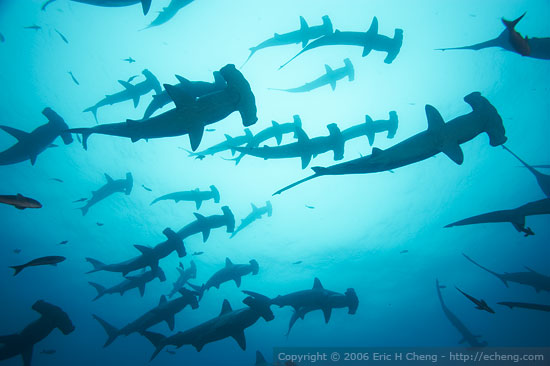
Hammerhead Sharks are commonly known because of their appearance. The Merriam-Webster Dictionary defines it as "any of a family (sphyrnidae) of active voracious medium-sized sharks that have eyes at the ends of lateral extension of the flattened head" This means that they are a shark that eats a lot, and who's eyes are placed in a rather intriguing position. Check out this Hammerhead on the right. Ugly isn't he?


Hammerheads eat smaller fish, octopus, squid, crustaceans, and even sting rays, which it pins to the ocean floor using its wide head. According to National Geographic, The Great Hammerhead Shark can grow to be 20 ft in length, and weigh over 1,000 lbs. Although most Hammerheads are rather small, the Great Hammerhead is among the top nine largest identified species of shark. Unlike a pet goldfish, who's lucky to live two weeks, the Hammerhead can live to be 30 years old, and spend their lives in both temperate and tropical waters, traveling in large groups, or schools.


Although the Hammerhead is a fish, babies are fed placenta, and are born, rather then hatched. Hammerheads are viviparous, which means that the eggs hatch inside the female's body, and that Hammerheads give birth to live young. Hammerheads can have anywhere from 13 to 42 babies, or pups, per litter. But despite the fact that Hammerheads have many pups, their population is declining. According to the MarineBio organization, "hammerheads are a bycatch species of tropical longline and drift net fisheries with highly valued fins". Hammerhead meat is also sold for human consumption, and can be bough fresh, frozen, dried, or smoked.


According to the Shark Foundation, Sharks existed 400 million years ago and have sense evolved into the species they are now. Hammerhead Sharks have evolved to have their current head structure which allows them 360° vision and greater stereo vision, or depth perception.


Hammerheads aren't rare, but are always interesting, and cool to see. Have fun watching SHARK WEEK, and remember: Fish are friends. Not food.


Tuesday, August 3, 2010

thINK Journal #1: HAPPY SHARK WEEK!!!!


Yup, its that time of year again: Shark Week.
Shark week premiered August 1st, on Discovery Channel.

After watching a couple of shows on Shark Attacks, I began to wonder what causes shark attacks.
According to the Australian Shark Attack Files, there have only been 53 shark attacks off the coast of Australia in the last 50 years.
Here's a look at the number of shark attacks in the United States over the past decade according to the International Shark Attack File:

In 1999 there were 37 shark attacks, none of them fatal.
In 2000 there were 53 shark attacks, only 1 of them fatal. In 2001, there were 50 shark attacks, 3 of them fatal.
In 2002 there were 47 attacks, none of them fatal.
In 2003 there were 40 shark attacks, with 1 fatality.
In 2004, there were 30 attacks, 2 fatal.
In 2005 there were 40 shark attacks with 1 fatality.
In 2006 there were 39 attacks, with no fatalities,
And in 2007 there were 50 shark attacks, again with no fatalities.
In 2008 there were 41 attacks, one fatal,
And finally in 2009 there were only 28 attacks with no fatalities.

According to the Florida Museum of Natural History: Ichthyology Department, You are more likely to be struck by lightning then to be attacked by a shark. The average number per year of deaths by lightning strikes is 38.6, where as the average shark attack per year is only 18.7. And the average death by shark attack is even lower: o.5 per year.

The primary reason sharks attack humans is because they mistake us for their prey. Our splashing around on the surface looks like panicked fish, and surfers floating on the surface on their boards resemble sea lions, part of the diet of a shark.

The two sharks that most commonly attack are the Great White: Shown in the picture above, and the Tiger Shark, to the left.
The Great White terrorises the temperate waters while the Tiger Shark hunts in the tropical waters. Despite how dangerous they seem to us, we are so much more dangerous to them. According to National Geographic 38 million sharks are killed per year.

If you can't tune in to Shark Week on your TV, you can check out all the bloody fun at Discovery Channel.com. So go get some popcorn, and prepare for the JAWS theme song. And remember: Fish are Friends. Not Food!